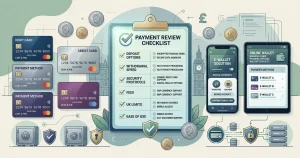
A cryptocurrency listing alone does not confirm USDC support; the currency must be tied to the account and intended transaction.

A casino account, a deposit method and a game are three separate things. A site may offer an account to UK customers, list a payment option in its cashier and provide slots in its games lobby, but those details do not automatically confirm that the payment option can fund that account or that a particular game is available to play. Treating them as interchangeable can lead you to make a decision on an assumption rather than on the operator’s stated terms.
That distinction matters when you are looking for a casino account that can be funded with USDC. A reference to cryptocurrency in general is not enough to show that USDC is supported. Nor does an account page, a games catalogue or a promotion establish that USDC deposits are accepted. The relevant information has to connect the specific currency with the account and the transaction you intend to make.
The reverse is also true: if a casino accepts a payment method, that does not mean it has games designed for that method. Depositing USDC, where an operator explicitly supports it, would be a way of moving funds into an account. It would not by itself determine which slots appear in the lobby, which games you can access, or whether a game is eligible for a particular offer. Payment support and game availability are separate operator decisions.
If you’re looking for a casino that accepts USDC in the UK, check that the payment option is currently available to you before depositing. The details below note the only known feature for each operator: payout speed.
Chanze
Chanze has a stated payout speed of 1–3 business days. No details are provided about USDC support.
Dieselwin
Dieselwin has a stated payout speed of 1–3 business days. No details are provided about USDC support.
WinBeast
WinBeast has a stated payout speed of 1–3 business days. No details are provided about USDC support.
Jetsetspins
Jetsetspins has a stated payout speed of 1–3 business days. No details are provided about USDC support.
NightWin
NightWin has a stated payout speed of 1–3 business days. No details are provided about USDC support.
Britsino
Britsino has a stated payout speed of 1–3 business days. No details are provided about USDC support.
Amunbet
Amunbet has a stated payout speed of 1–3 business days. No details are provided about USDC support.
EvoSpin
EvoSpin has a stated payout speed of 1–3 business days. No details are provided about USDC support.
Zombillion
Zombillion has a stated payout speed of 1–3 business days. No details are provided about USDC support.
Revery Play
Revery Play has a stated payout speed of 1–3 business days. No details are provided about USDC support.
This is why phrases such as “USDC slots” can be misleading. They may suggest that the currency is built into a slot or that a special category of games is tied to USDC. A payment method alone cannot establish either point. To make a claim about a specific slot, you would need clear game information from the casino; to make a claim about a USDC deposit, you would need clear payment information. One cannot stand in for the other.
The same care applies to bonuses. A promotion may have its own eligibility conditions, and the payment route may matter independently of the games included in the offer. A specialist casino review has described PayPal as convenient for payments while noting that it may be excluded from bonus eligibility. That is a report about a particular source, not a rule you can assume applies across casinos. Specialist reviews have also reported that Skrill and Neteller may be excluded from promotions at some sites. Check the operator’s current promotion terms rather than inferring eligibility from the fact that you can open an account or make a deposit.
For any offer, keep the questions distinct: does the account accept the payment method; does the promotion allow deposits made through it; and are the games you intend to play included under the offer’s terms? A positive answer to one does not settle the others. This matters especially when a headline or a brief description groups a payment method, a bonus and slots together without explaining the conditions behind each.
A list of casinos described as accepting USDC would be useful only if its entries were supported by current, operator-specific information. A list of games described as playable with USDC would require a different kind of confirmation. Without both kinds of detail, a combined list risks implying a connection that has not been established. The same applies to claims about “the best” slots: ranking games requires information about the games themselves, not just a payment option associated with an account.
In the UK, the legal status of the casino is also separate from its payment and game features. Remote gambling businesses serving customers in Great Britain must hold the relevant Gambling Commission licence. A licence does not, on its own, prove that USDC is accepted, that a bonus applies to a particular payment route, or that a named slot is available. Those are distinct details to establish with the operator.
Before you rely on a description of a casino, read it as a set of separate claims rather than one promise. An account may be available, a payment method may or may not be supported, a promotion may carry payment conditions, and games may be offered on their own terms. Keeping those distinctions clear helps you assess what a casino actually offers without assuming that USDC access guarantees a particular bonus or a particular kind of slot play.
A reference to “cryptocurrency” is not enough to establish that a casino accepts USDC. It may refer to other digital currencies, or to a payment arrangement that does not include USDC at all. Before you fund an account, look for USDC named specifically in the casino’s own payment information.
Start with the cashier while logged in, if the site requires an account to display payment options. Check the deposit screen for a separate USDC choice, rather than relying on a general crypto label or a logo elsewhere on the site. If the cashier lets you select USDC, read the instructions shown for that option before proceeding. The payment route should be described clearly enough for you to know that the casino is accepting USDC, not merely directing you to a third-party service that handles other payments.
Then compare the cashier with the operator’s payment terms. Look for explicit wording that identifies USDC as an accepted deposit method and explains any conditions attached to it. Terms may distinguish between payment methods, account currencies or customer locations. A page that mentions several cryptocurrencies without naming USDC does not confirm that USDC deposits are available to you in the UK.
A specialist casino review can be useful as a starting point, but it should not replace the operator’s current cashier and terms. A review may group different cryptocurrencies together or describe a payment option that has since changed. Treat that wording as a prompt to check the live site, not as confirmation that a particular token is accepted now.
Check that the payment choice is specifically labelled USDC and that the instructions match the deposit process you are being asked to follow. If the site shows a wallet address or payment request, do not assume that it is safe to send funds simply because the page uses a crypto logo. Confirm that the casino’s own terms identify the method and that the transaction instructions come from the operator’s cashier.
Also check that you are viewing the UK-facing version of the site and the correct account. Payment options can be presented according to location or account settings, so a method described on another version of a website may not be offered to you. If the cashier does not show USDC, or its wording is unclear, ask the operator through its official support channel whether USDC deposits are currently supported for UK customers. Keep the answer specific: ask about USDC, not cryptocurrency in general.
Do not treat a Bitcoin option as evidence of USDC support. They are different payment choices, and a casino that accepts one does not thereby confirm the other. The same applies when a site lists Visa, Mastercard, bank transfer, e-wallets and several cryptocurrencies: the broad list does not tell you which individual cryptocurrencies the cashier accepts.
The payment method, instructions and account details should agree before you send money. If the cashier names one method but the terms name another, or support gives a general answer without confirming USDC, wait for clarification. A transfer to an address that is not intended for the stated payment method may not be credited as you expect, and resolving a mistake can involve delays or further checks.
Avoid relying on an address copied from an old message, a search result or a public discussion. Use the current instructions displayed inside the operator’s own account area, and do not proceed if you cannot establish that they relate to a USDC deposit. Never share account passwords, private wallet credentials or recovery phrases with casino support; those are not needed to confirm which deposit methods the site accepts.
The operator’s regulatory status is a separate check from payment support. A payment logo or a USDC option does not establish that a casino is authorised to serve UK customers. Remote gambling licensees offering gambling to people in Great Britain must hold the relevant UK Gambling Commission licence. Check the operator on the Commission’s public register before depositing; a payment method cannot substitute for that check.
A useful decision rule is straightforward: proceed only when the casino’s current cashier clearly names USDC, its terms do not contradict that information, and the operator confirms the option if anything remains ambiguous. If those checks do not line up, do not send funds on the assumption that a general reference to crypto includes USDC.
A casino that accepts cryptocurrency does not necessarily accept USD Coin (USDC). Payment pages and specialist casino reviews may mention several cryptocurrencies alongside Visa, Mastercard, bank transfers and e-wallets, but a general reference to crypto is not confirmation that USDC can be used.
So, can you use USDC at an online casino serving the UK? Only if that operator explicitly supports it for your account and displays it as an available payment method. Without that confirmation, treat USDC acceptance as unknown rather than assuming that a site’s other crypto options include it. The same caution applies when looking for a casino that pays out in USDC: support for one payment route does not establish support for another.
This makes broad claims about the “best” USDC casinos difficult to rely on. A list may repeat an operator’s general cryptocurrency wording without showing whether USDC is accepted, whether it can be used by UK customers, or whether the option is currently available. A casino’s payment arrangements can change, so a description elsewhere is not a substitute for the operator’s own current terms.
For a UK player, the operator’s regulatory status matters as well as its payment claims. Real-money casinos serving customers in Great Britain must hold the relevant UK Gambling Commission licence. A crypto payment option does not itself show whether an operator is licensed or whether its arrangements meet UK requirements. Check that the operator is on the Commission’s public register before depositing.
It is also useful to separate two different questions: whether a casino accepts USDC, and whether you want to use it. USDC is a cryptocurrency; its name alone does not tell you what the casino will credit to your account, how the transaction will be handled, or whether the method fits your circumstances. Do not treat a broad “crypto accepted” statement as an answer to those practical points.
If you cannot find USDC named in the operator’s payment information, do not assume that another coin, a wallet, or a third-party service will make it work. A route that changes the payment method along the way may not be treated as direct USDC support. The operator’s stated options and conditions are what matter.
For now, the careful answer is conditional: some casino-related material refers to sites accepting several cryptocurrencies, but that does not establish that a particular UK-facing casino accepts USDC. You should regard a site as a USDC option only when its own current information clearly identifies USDC for the relevant transaction and customer location. Avoid relying on an old review or an unspecific crypto label when deciding where to deposit.
USDC and a debit card are different kinds of payment route. USDC is a cryptocurrency; a card payment is authorised through a card account. A casino mentioning Visa or Mastercard is referring to card payments, not confirming that it accepts USDC. Likewise, a reference to cryptocurrency does not show that a debit card can be used to fund a USDC payment.
UK casinos commonly accept debit cards, including Visa and Mastercard, but that does not mean every card product or transaction will be eligible. The distinction that matters for gambling is between debit and credit: credit-card payments for gambling have been prohibited in the UK since 14 April 2020. The restriction remains in force, so a credit card is not an alternative to a debit card at a UK-licensed casino.
This is relevant even when a payment appears to pass through an intermediary. Remote gambling operators cannot accept credit-card payments for gambling routed through a money service business, and they cannot accept wallet payments where the wallet permits credit-card funds to be used for gambling. A different label or an extra step in the payment chain does not make credit funding permissible.
When you see a casino describe its payment options, read the terms precisely. “Cards accepted” should not be taken to mean that credit cards are allowed; in the UK casino context, card acceptance means an eligible debit card. Nor does it establish anything about USDC. These are separate questions: whether the casino offers a debit-card route, whether your particular card can be used, and whether USDC itself is an available payment method.
Searches for casinos accepting USDC by card can blur those distinctions. A card may be used to access funds in some financial services, but that alone does not prove the casino accepts USDC, or that the service’s route is permitted for gambling. Do not treat a card logo beside a cryptocurrency reference as confirmation that the two can be combined. The payment description needs to identify the actual method and its permitted funding source.
For a UK casino deposit, use only an eligible debit-card route if paying by card. If you are looking for a USDC option, assess that separately rather than assuming it falls under the casino’s card acceptance. In particular, do not try to route credit-card funds through a wallet or intermediary to make a gambling payment. The UK restriction applies to the funding route as well as to a direct credit-card transaction.
A casino’s payment options and its games catalogue are separate parts of the service. USDC is a stablecoin payment method; it does not identify a particular slot, guarantee access to a game, or indicate what is available on mobile. A casino could offer a broad range of games without accepting USDC, or support a payment method without offering any particular title. Neither detail proves the other.
That distinction matters when you are comparing casinos described as suitable for USDC play. A page mentioning cryptocurrency does not, by itself, establish that USDC can be used there. Nor does a claim about a casino’s games tell you anything about its payment arrangements. Treat those as separate questions, and avoid relying on a games list or promotional description as evidence of payment support.
The same caution applies to requests for the best games at a USDC casino. “Best” can mean different things: a player might be looking for a particular style, feature or pace, while a casino may present its catalogue in categories that change over time. Without reliable details about a specific operator’s current games, a recommendation would risk promising a title or selection you may not find. Check the operator’s own games area for the titles actually available to your account.
Mobile access is another separate issue. A site being usable on a phone does not show that every game works on every device, and it says nothing about which payment methods the cashier accepts. If you plan to play on mobile, look at the game itself on your device and check the operator’s terms and account information separately.
Bonuses also need to be considered independently from both games and payment methods. A promotion may have its own eligibility rules, and a game’s presence in the catalogue does not establish that it contributes to a bonus or qualifies for a particular offer. Read the promotion terms before accepting it rather than assuming that a USDC payment or a preferred slot will meet the conditions.
In Britain, online slots are subject to specific play rules. Autoplay is not permitted, and a slot spin must last at least two and a half seconds. The maximum stake per game cycle is £5 for customers aged 25 and over, and £2 for customers aged 18 to 24. These restrictions concern how online slots are played; they do not indicate that a casino accepts USDC or that a particular slot is available.
For a useful comparison, assess the payment method, games catalogue, mobile experience and promotion terms as distinct features. If a casino names particular games, confirm that those titles appear in its current catalogue. If it describes a payment option, check the cashier and relevant terms rather than inferring support from the games on offer. A clear separation between these details helps prevent a search for USDC-friendly play from turning into an assumption about games, bonuses or mobile access.
If you cannot use USDC, or would rather avoid a cryptocurrency transaction, UK casino cashiers may offer bank transfers, prepaid vouchers or e-wallets. These are different payment routes, not interchangeable versions of the same service: some are deposit-only, while others may support both deposits and withdrawals. Availability depends on the casino, so compare the options shown for your own account.
Direct routes from bank accounts that can provide instant deposits and fast withdrawals.
Deposit-only options like Paysafecard used to control the amount loaded onto a payment method.
Services such as Skrill or Payz (formerly EcoPayz) often listed as deposit options.
Open banking and bank transfers can be practical alternatives when you want to move money directly from a bank account. A specialist payment review reports that these routes can provide instant deposits and fast withdrawals at many sites, although that does not mean every casino offers them or processes them on the same schedule.
Check which transfer service the cashier names and whether it is available through your bank. The option displayed at one casino does not establish that another accepts the same route. Use an account in your own name; matching account and payment details can help avoid preventable ownership checks.
Paysafecard is a prepaid voucher for deposits. It is deposit-only, so do not choose it expecting to receive a casino withdrawal through the same voucher. You would need to understand the operator’s withdrawal arrangements before depositing, particularly if you want a straightforward route for both directions.
A voucher may suit someone who wants to control the amount loaded onto a payment method, but that does not make it a universal alternative to USDC. Its usefulness depends on whether the casino accepts it and how you can later withdraw any balance.
Skrill is a frequently listed deposit option at UK-facing casino sites, according to specialist casino reviews covering 2026. That makes it one option to look for in a cashier, not a guarantee that a particular casino accepts it or that it qualifies for every promotion. Read the operator’s payment and bonus terms before relying on it.
You may also encounter Payz, the name adopted by EcoPayz in 2022. Check the cashier for the current name and confirm the specific service is supported; an old reference to EcoPayz may not explain what is available to you now.
There is no single best USDC alternative for every player. Compare the payment route you can actually use, whether it supports the transaction you need, and the casino’s terms. A method appearing in a general payment list is not enough to establish that it is available for your account.
A payment method can appear on a casino’s information page without being available for your account or in your chosen currency. Before making a deposit, sign in and check the cashier: the options shown there are more relevant to your transaction than a general list elsewhere on the site.
Currency deserves a separate check. A specialist review reports GBP support on the pages it examined, but that does not establish the currency setting for every account. Confirm the currency displayed in your account and at the payment stage before you proceed. If your balance is held in another currency, a conversion may affect the amount credited or returned.
For anyone considering casinos that accept USDC in the UK, the same practical check applies: make sure the cashier presents the payment route for your account, rather than relying on a broad reference to cryptocurrency. The label should match the asset and route you intend to use. Do not treat an option with a similar name, or a general crypto reference, as confirmation that it will work for your transaction.
Check that the payment account belongs to you and that its details match the casino account. Using one named account consistently for deposits and withdrawals is often the cleanest route. Different names or account details can create avoidable questions about who owns the funds and may require further checks.
Before confirming, read the payment instructions shown by the casino and your provider. Check the currency, the amount to be charged, any conversion notice, and whether the displayed route is available for the transaction you are about to make. If any of these details are unclear or conflict with the information in your account, pause and ask the operator or provider to clarify them. A payment that appears to have been submitted is not proof that it has reached the casino balance.
Keep a record of the terms and confirmation shown at the time of payment. Availability can change, so an old page or a previous transaction may not describe what is offered now. Your decision should be based on the current cashier and the account details presented before you authorise the payment.
This check is separate from deciding whether a casino accepts a particular asset: it is about whether the route, account and currency line up for your own transaction. Take the time to confirm those details before sending funds.
A casino accepting a deposit through a payment method does not automatically mean it will pay withdrawals through that same route, or that the payout will arrive quickly. Check the withdrawal terms as well as the deposit options before you commit funds. This matters if you are looking for casinos with USDC withdrawals in the UK: a reference to cryptocurrency, or to USDC deposits, is not confirmation that USDC can be used to receive a payout.
UK anti-money laundering rules generally require a casino to return funds to the original payment source. This closed-loop approach helps the operator confirm where the money came from and where it is going. If a casino cannot return the full amount to that source, it may ask you to use another method or complete additional checks. Do not assume that a bank account, card, e-wallet or crypto wallet can be substituted without approval.
Use payment details that belong to you and match the details on your casino account. A mismatch can create avoidable questions about ownership and may delay a withdrawal. The casino may also request KYC documents before releasing funds, particularly when the account has not yet completed verification. Responding to a request does not guarantee an immediate payout: the operator still needs to review it.
A withdrawal’s elapsed time includes the casino’s own approval stage, not just the time taken by the payment provider. A specialist review describes first withdrawals as potentially taking longer while verification is completed; treat that as a possibility, not a fixed timetable. Check the cashier or withdrawal terms for the operator’s stated process, and look for any pending checks in your account.
A specialist review also identifies PayPal, open banking services and debit cards connected to fast payout systems among the quicker withdrawal routes. That is not a promise about any particular casino or transaction. The operator’s approval process and your account status can affect when funds are released.
Before depositing, confirm that the named method is available for withdrawals and that the account holder details match. If a site claims to offer USDC payouts, check that the withdrawal terms explicitly say so and explain the process. For gambling offered to people in Great Britain, the remote gambling licensee must hold a UK Gambling Commission licence; a payment option alone does not establish that status.
A minimum deposit is set by the casino and may differ by payment method. A specialist casino review puts common starting points in the £10–£20 range, but that is not a guarantee for any particular account or cashier. If you are considering a USDC deposit, do not treat that range—or a low figure mentioned elsewhere—as confirmation of the minimum. The amount shown for the selected method at checkout is the relevant one.
Maximums can also differ. A casino may set separate caps per transaction, per day or per month, and the amount available can depend on your payment method and account status. Check the limit displayed before committing funds. If the cashier does not make the applicable cap clear, ask the operator rather than relying on a general payment guide.
The amount debited from you may not be the same as the amount credited to the casino balance. Costs can arise from the casino, the payment provider, your card issuer or bank, currency conversion, or the payment network. A conversion spread can be less visible than a stated fee, so compare the amount you send with the value the casino says it will credit. For a USDC transaction, establish whether any conversion or network cost applies and who charges it; do not assume the displayed deposit amount is the full cost.
Promotional terms are another separate calculation. A deposit offer does not establish that USDC is accepted, nor that a particular deposit amount qualifies. Likewise, a no-deposit offer is not evidence that you can make a USDC deposit or that a deposit bonus will be available. Read the offer conditions and payment terms separately before counting any bonus towards the value of a transaction.
Before confirming, note the deposit minimum, applicable maximum, currency and any fee shown by the casino or provider. If a charge is not clear, pause and get an explanation first. This gives you a more realistic picture of what the transaction will cost than relying on a headline minimum alone.
A casino’s payment options do not tell you whether it is covered by GamStop. Accepting USDC, or another cryptocurrency, is not evidence that an operator is registered with the scheme, and the absence of USDC says nothing about its status either. Treat payment support and self-exclusion coverage as separate checks; do not rely on phrases such as “not on GamStop” as proof that a site is suitable or safe for you.
If you are considering an operator, check its GamStop status directly and read the responsible-gambling information on the site. UKGC-licensed casinos must provide tools such as self-exclusion. Those controls matter regardless of the currency or payment route you use. A deposit method cannot replace a self-exclusion measure, and a casino’s own account controls should not be assumed to provide the same protection as GamStop.
Pay particular attention to the limit-setting process. Remote operators must prompt new customers to set a financial limit before their first deposit and make account-level limit controls accessible. Before depositing, find those controls in the account area and understand what they let you restrict. If you have already chosen to self-exclude, do not treat a different payment method or a site described as outside GamStop as a way around that decision.
Searches for USDC casinos “without GamStop” can blur two questions: how a deposit is made and what safeguards apply to the operator. Keep them distinct. Confirm the operator’s status independently, then consider whether its available controls match the protection you need. If you cannot establish the status or locate clear information about limits and self-exclusion, pause rather than using a payment option as a substitute for reassurance.
PayPal, open banking and debit cards linked to fast payout systems are generally among the quickest options. Your withdrawal speed also depends on the casino’s approval process and whether your account is verified.
Returning funds to the original payment source is a common anti-fraud and anti-money-laundering control. Using another route may involve additional verification.
Yes, Skrill is available at some UK-friendly casino sites. It may be excluded from promotions, so check the offer terms before depositing.
Yes, GBP is supported at the sites described. Confirm your account currency in the cashier before your first transaction to avoid conversion.
The minimum deposit usually starts at £10–£20, depending on the payment method.
There is no universally lowest-fee method. Compare casino and provider charges, currency conversion spreads and any network costs for your specific deposit.
Verification may be needed, particularly for a first withdrawal, and can add time to processing. Keeping your account details and payment method in your own name can help avoid unnecessary transaction delays.
No. Check the cashier to confirm that your specific Visa or Mastercard product is eligible; credit card gambling has been banned in the UK since 14 April 2020.