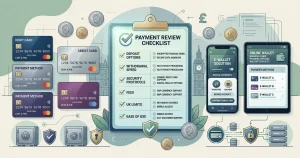
A guide to bank-linked casino payments, approval screens, account consistency, limits and the difference between deposits and withdrawals.

Open Banking describes a way for you to authorise a payment through your bank rather than entering card details into a casino cashier. At a site that offers this route, the cashier can direct you to your bank or its app to approve a transaction. The payment is then made from your bank account. The exact screens and steps depend on the bank and the service used.
A bank transfer is the movement of funds between bank accounts. Open Banking can be used to initiate that movement, but the terms are not interchangeable: a casino may offer a bank transfer without presenting it as an Open Banking payment, or provide an Open Banking service as a particular route in its cashier. The label alone does not tell you how the payment will be handled or whether it is available for your account.
For a casino deposit, the practical distinction is that you approve the transaction through a bank-linked process instead of entering a debit-card number. You should see the payment amount and be asked to authenticate it through your bank. Read the details on those screens before approving; a payment request should match the amount you intend to send and the casino account you are funding.
Open Banking does not mean that every casino connects to every bank, or that every account can use the same payment route. Availability depends on what the casino and its payment provider offer, as well as what appears for you in the cashier. A site describing itself as an online casino that accepts Open Banking is not enough to confirm that the option will be available when you try to pay. The cashier is the useful place to check.
There is also a difference between an Open Banking payment and signing in to online banking on a casino’s own page. Follow the authentication process shown by the payment service and your bank, and do not share your banking password directly with a casino. If the payment flow is unexpected or the recipient details do not look right, pause rather than authorising it.
Some specialist casino reviews describe Open Banking and bank transfers as routes that can support instant deposits and fast withdrawals at many sites. That is a possibility, not a promise for every operator or transaction. A payment can depend on the service offered, the bank’s handling of it and the casino’s own process. Treat any speed claim as something to verify for the specific site, rather than assuming that “Open Banking” means immediate movement in both directions.
A deposit and a withdrawal are separate actions, even when both involve a bank account. An account-to-account payment may be used to fund play, while a withdrawal may be handled through a casino’s payout process and the route it supports. The presence of an Open Banking logo or option at deposit does not, by itself, confirm that the same route can receive withdrawals. Check the cashier’s information before relying on it for both.
For UK players, use a remote gambling licensee authorised for the British market. Payment technology does not establish whether a casino is licensed: it is a separate matter from the method used to move money. A familiar bank interface should not be taken as proof of the operator’s status.
If you are considering an Open Banking casino site, think of the label as a description of a payment route, not a guarantee of availability, timing or withdrawal support. Check what the cashier actually offers, follow the bank’s approval steps carefully, and keep the payment decision separate from assumptions about how quickly funds will arrive.
When you use Open Banking to fund a casino account, the bank account and payment route should belong to you. Keeping those details consistent can reduce avoidable questions about who supplied the funds and where a withdrawal should go. It is a practical way to make the transaction history easier to understand, not a guarantee that every payment will be accepted without checks.
A straightforward arrangement is to register with your own details, deposit from a bank account in your name and use that same named account as the route for withdrawals. Where an Open Banking service connects your bank to the casino, make sure the account you select is yours. The aim is for the casino account, the bank account and the payment record to point to the same customer.
This matters because payment checks are not concerned only with whether money can be sent. A casino may need to establish that the person making a deposit is the account holder and that a withdrawal is being directed to an appropriate source. If names or account details do not line up, the casino may need to clarify the discrepancy before it can process the transaction. Consistency makes the basic ownership picture less ambiguous.
The cleanest route is often one named account used consistently for both depositing and withdrawing. Switching between accounts or using payment details that belong to someone else can make the funds trail harder to follow. Even where you have a legitimate reason for using a different account, a mismatch may lead to additional questions rather than a simple transaction.
Do not use a partner’s, relative’s or friend’s bank account to fund your casino play. Permission from that person does not make the account yours, and it does not make the payment details match your casino registration. A shared household arrangement can still create an ownership mismatch if the account is held in someone else’s name. Keeping the payment in your own name avoids that particular source of confusion.
Take care when choosing the bank account in an Open Banking payment flow. If you hold more than one account, select the one you intend to use consistently. A payment initiated from an account that is not yours, or from details that do not correspond to your registered identity, can create questions that would not arise with a clear, single-customer route.
Use accurate personal information when opening and maintaining the casino account. If your bank account is in your name but the casino account contains different or incomplete details, the records may not align. Correcting an error before making a payment is simpler than trying to explain it after a transaction has prompted a check.
If your name or other personal details have changed, keep the relevant accounts up to date. The important point is that the casino can understand that the person named on the payment route is the same person who holds the gambling account. Where a difference cannot be resolved from the information already provided, be prepared to clarify it through the casino’s process.
Avoid making assumptions based on the word “direct” in a payment description. A direct bank payment does not remove the need for the casino to consider who owns the account or whether the route fits its requirements. The payment label describes how funds are moved; it does not establish that another person’s account can be used on your behalf.
If you need to change the account you use, do not alternate between accounts casually. Check the casino’s instructions and update your payment details through the appropriate channel before relying on a new route. This helps keep the record coherent and gives you a chance to address any ownership questions before they become an obstacle to a transaction.
Keep your own record of which bank account you used and the details you supplied. That can help you explain a transaction if the casino asks for clarification. It is also sensible to use a payment route you can continue to access, rather than one tied to an account you are closing or no longer control.
Open Banking can make a bank-funded casino payment feel direct, but the underlying ownership still matters. Using your own named account for deposits and withdrawals gives the casino a clearer line between the customer and the money. It cannot guarantee that no further checks will be needed, but it can reduce avoidable friction caused by mismatched account information or a route that belongs to someone else.
An instant deposit can make a bank-funded casino payment feel straightforward: you authorise a payment and the funds may appear in your casino balance without the wait associated with some transfers. Open Banking and bank transfers can support instant deposits at many sites, but this is not a promise that every casino, bank or transaction will work at the same speed. A specialist casino review describes these routes as capable of instant deposits and, at some sites, fast withdrawals; treat that as a possibility to verify, not a service standard applying everywhere.
The distinction matters if you are looking for a casino that accepts direct banking deposits in the UK. “Direct banking” can describe different bank-based payment routes, and a cashier’s wording does not by itself establish how quickly a particular transaction will be credited. Check the payment option shown for your account and the information given before confirming. If the cashier does not clearly explain what to expect, do not assume that the word “instant” applies to your payment.
A deposit and a withdrawal are separate transactions. Seeing money credited quickly after you pay does not tell you how long a later withdrawal will take. A fast deposit is not evidence of an instant withdrawal, nor does it establish that the casino will process both directions through the same route. If your decision depends on getting money back quickly, look for the withdrawal information rather than relying on a deposit-time claim.
This is also why “instant banking” should not be read as a guarantee about the whole account experience. It describes a possible payment speed, not a promise that a deposit will be accepted, that every bank is supported, or that a payout will arrive immediately. The precise route, the casino’s handling of the transaction and the information displayed in its cashier all matter. Consider the wording a claim to check, rather than a reason to assume that your own payment will follow the fastest possible path.
Searches for an Open Banking casino with a no-deposit bonus or free spins can create another misleading connection. A payment method and a promotion are separate things. The fact that a site accepts direct bank payments does not establish that it offers a no-deposit bonus, that free spins are available, or that either offer can be claimed by depositing through Open Banking. Do not treat a general payment description as evidence of a particular promotion.
If an offer is important to you, read its terms on the casino’s own site before making a deposit. Check whether the offer exists, which customers can claim it, and whether the payment route you intend to use is eligible. Promotion conditions can be specific to a particular offer; a broad statement that a casino accepts bank payments cannot answer those questions. If the terms do not clearly cover your payment method, ask the operator before depositing rather than relying on an assumption.
The same care applies when a page describes an online casino as accepting direct banking deposits. That description may help you identify a possible route, but it is not a guarantee of instant credit or a bonus attached to the route. Confirm the available option in the cashier for your account and read any relevant conditions before you proceed.
A sensible expectation is narrow: Open Banking or a bank transfer may let you deposit instantly at a site that supports it. That can be useful, but it does not settle how a later withdrawal will be handled, or whether a promotional offer applies. Keep those claims separate and check each one on its own.
A direct-banking option can look similar across casino sites while differing in the details that affect your transaction. Rather than treating one route as the best for everyone, compare what the cashier shows for your account: the currency, any charges, the amount you intend to move and whether the terms fit how you plan to use the account.
Start with currency. A specialist review reports GBP support on the pages it assessed, but that is not a guarantee that every account or payment route will use pounds. Confirm your casino account currency before making a first transaction. If the account is set to another currency, conversion may affect the amount credited or the value of a withdrawal. Check the displayed rate and any conversion information rather than assuming that a pound-denominated bank account means the casino balance is also in pounds.
Then compare the full transaction cost, not just a headline fee. A specialist review notes that the total can involve charges from the casino, the payment provider or your bank, as well as currency-conversion spread and network costs. Which of these applies depends on the route and transaction. A route with no visible flat charge may still cost more after conversion, so compare the amount leaving your bank with the amount credited to the casino balance. Use the actual amount you plan to transfer; a comparison based on a different sum may not reflect your costs.
A total cost can involve charges from the casino, the payment provider or your bank, as well as currency-conversion spread and network costs.
Keep the comparison specific to the direct-banking option presented to you. “Bank transfer” and “Open Banking” can describe different payment flows, and a label alone does not tell you what will happen in your account. Record the route name, the currency shown and any fee or conversion details before deciding. If the information is unclear, do not infer that another site’s terms apply.
Searches for a direct-banking casino may also mention a no-deposit bonus. Treat that as a separate question from payment compatibility. A bonus may have its own eligibility rules, and the payment label does not establish that an offer exists or that you qualify for it. Read the offer terms and check whether they address the account and payment route you intend to use before relying on a promotion in your comparison.
A useful comparison is therefore practical rather than absolute: which option shows your account currency, what total amount is debited and credited, and whether the stated terms match your intended transaction. If the cost or currency is not clear before you proceed, pause and seek clarification instead of choosing on the strength of a “best” label.
When choosing a casino for direct banking, you should check the available payment details and how long withdrawals may take. Use the stated payout time here as one point to consider.
Chanze
Chanze has a stated payout speed of 1–3 business days. You can use this as a guide when considering withdrawal timing.
Dieselwin
Dieselwin has a stated payout speed of 1–3 business days. You can use this as a guide when considering withdrawal timing.
WinBeast
WinBeast has a stated payout speed of 1–3 business days. You can use this as a guide when considering withdrawal timing.
Jetsetspins
Jetsetspins has a stated payout speed of 1–3 business days. You can use this as a guide when considering withdrawal timing.
NightWin
NightWin has a stated payout speed of 1–3 business days. You can use this as a guide when considering withdrawal timing.
Britsino
Britsino has a stated payout speed of 1–3 business days. You can use this as a guide when considering withdrawal timing.
Amunbet
Amunbet has a stated payout speed of 1–3 business days. You can use this as a guide when considering withdrawal timing.
EvoSpin
EvoSpin has a stated payout speed of 1–3 business days. You can use this as a guide when considering withdrawal timing.
Zombillion
Zombillion has a stated payout speed of 1–3 business days. You can use this as a guide when considering withdrawal timing.
Revery Play
Revery Play has a stated payout speed of 1–3 business days. You can use this as a guide when considering withdrawal timing.
“Direct banking” can describe more than one route. A casino may mean an Open Banking connection, a standard bank transfer, or a payment service that links to your bank. The label alone does not tell you which one is available to you. Before relying on it, sign in and check the cashier rather than treating a general payment page as confirmation.
Open the deposit options and look for the exact route offered. If the cashier names an Open Banking service or a bank-transfer option, read its instructions and check what information or authorisation it requires. A bank transfer and an Open Banking payment are not necessarily interchangeable: one route appearing on a site does not prove that the other is supported.
Availability can depend on the account and the transaction, so check while signed in. Confirm that the option appears for your account and that the cashier lets you select it for the intended deposit. If it is absent, unavailable or produces an error, do not assume that a different bank route will work. Ask customer support to confirm what is currently enabled before trying another method.
Check the account currency before you make a payment. A specialist casino review may state that GBP is supported, but that does not confirm the currency set for your own account. Look for the currency displayed in the cashier or account settings and make sure it matches what you intend to use. If it does not, ask the operator how a payment would be handled before proceeding.
Do not treat deposit availability as proof that the same route is available for withdrawals. Check the withdrawal cashier separately and read any instructions shown there. If bank payment is not listed for withdrawals, ask support how the operator handles a bank-funded account and what options apply to your situation. This is more reliable than assuming that a payment route works in both directions because it appears in one part of the cashier.
Read the payment terms linked from the cashier, including any conditions attached to the route. Make sure the selected bank and payment service are supported, and follow the steps shown on the operator’s own screen. If the cashier redirects you to a service, check that the payment details and recipient information are consistent with the transaction you intended to make. Stop if the amount, currency or destination differs from what you expected.
A claim that a casino accepts direct banking is also not evidence that it is authorised to serve customers in Great Britain. Check the operator’s current licence on the UK Gambling Commission’s public register before depositing. UK remote gambling licensees must hold the relevant licence, wherever the business is based.
If the cashier and the operator’s terms do not clearly confirm the route, pause and ask support for a direct answer about your account. That small check can prevent you from sending money through a method that is not available for the transaction you planned.
A bank-funded payment is still subject to limits set by the casino and the payment route. If you are considering a direct banking casino in the UK, check the cashier’s current terms rather than assuming that a figure shown elsewhere applies to your account. Minimums and maximums can differ between payment methods, and the limits available to you may also depend on your account status.
A specialist casino review reports that minimum deposits may start within the £10–£20 range, depending on the selected method. Treat that as a guide to what one review reports, not a guaranteed minimum across UK direct banking casinos. The cashier should show the amount accepted for your chosen route before you confirm a transaction. If the displayed minimum is higher than you planned to deposit, do not raise your spend simply to meet it.
Maximum deposit limits can apply per transaction, per day or per month. A specialist casino review notes that these ceilings vary by payment method and account status. That means an amount accepted on one route may not be accepted on another, and an account’s available ceiling may differ from a general figure in a review. Check the limit shown for your own account and the period it covers before making a payment.
Your own financial limits are separate from a casino’s transaction caps. UK Gambling Commission rules require remote gambling operators to prompt new customers to set a financial limit before they make their first deposit. They must also make account-level limit controls accessible. These safeguards are meant to let you set boundaries on your spending; they do not change the payment method’s deposit ceiling or guarantee that a transaction will be accepted.
Before depositing, look for the limit controls in your account and consider setting a boundary that reflects what you can afford to lose. If you later want to reduce a limit, use the account controls and check how the operator applies the change. A casino cap is not a personal spending plan: it may allow more than you intend to spend, while your own limit can keep the amount lower.
It is also worth distinguishing a declined transaction from a limit being reached. If a payment does not go through, check the amount and the applicable limit in the cashier before trying again. Repeated attempts at different amounts can make it harder to keep track of your spending. If the limit or its reset period is unclear, ask the operator to explain it rather than guessing.
For a casino with direct banking in the UK, the useful figures are the ones currently displayed for your account and selected payment route, alongside the limits you have chosen for yourself. Read both before confirming a deposit. A payment ceiling tells you what the casino may accept; an account-level financial limit helps you decide what you are prepared to spend.
An Open Banking payment is one route through a casino cashier, not a sign that every other method will be available or interchangeable. The options shown can vary between sites and may also depend on your account. Check the cashier itself before choosing how to fund play, rather than relying on a general payment list.
Debit cards are another established option: UK casinos commonly accept Visa and Mastercard debit cards. Still, a method appearing on a casino’s information page does not confirm that it is available to you now, or that the same route can be used for a withdrawal. Check both points before making a deposit. Do not confuse debit cards with credit-card payments for gambling, which UK-licensed casinos cannot accept.
Prepaid vouchers work differently. Paysafecard is deposit-only, so it is not a route for receiving a withdrawal. If you choose it, consider in advance how the casino handles any balance or winnings that need to be paid out; the cashier or its terms should explain the available process.
E-wallet availability also varies. Skrill and Neteller are offered at some sites, but a specialist review has reported that these methods may be excluded from promotions. That is a reason to read the specific offer’s terms before depositing, not to assume that every casino applies the same rule. A payment method can be accepted while still being ineligible for a particular promotion.
For any method you are considering alongside banking, check the current cashier for three things: whether it accepts deposits, whether it supports withdrawals, and whether the relevant offer allows its use. These details can differ by site and may change. If a method is deposit-only, or its promotion status is unclear, do not treat it as equivalent to a bank route that supports both directions.
The practical choice is the one that fits the transaction you intend to make. Confirm the available options in your own account and read the payment and promotion terms before proceeding; a method’s presence in a general list alone does not establish compatibility.
A payment can reach your casino account quickly without making a later withdrawal equally quick. A deposit and a payout travel through different steps: the deposit is credited, while a withdrawal must be reviewed and sent back through an eligible payment route.
A specialist review notes that a card deposit can be instant even though the payout takes several business days. The same distinction matters when you use Open Banking or another direct-banking route. A fast deposit does not confirm how quickly the casino will approve a withdrawal, or how long the payment will then take to reach your bank.
After you request a payout, the casino may first carry out internal approval checks. A specialist review also notes that a first withdrawal can take longer when verification is still being completed. If the casino asks for documents, the request may remain pending until the checks are resolved. That means the time shown for a payment route may not include the casino’s own review stage.
There is also a return-to-source control. UK anti-money laundering rules generally require winnings to be paid back to the original payment source. This is part of the closed-loop approach to funds: the account used to deposit can affect where a withdrawal is sent. If the casino cannot return the money by that route, an alternative may require additional checks.
When comparing claims about a direct-banking casino withdrawal, look for separate information about approval and transfer time. “Instant withdrawal” may describe only one stage, or it may be conditional on account checks and the payment route available to you. Treat the estimate as a guide, not a promise that funds will appear immediately.
Before requesting a payout, check that your account verification is complete and read the cashier’s withdrawal status and timing notes. If a request is pending, check whether the casino needs information from you before assuming the bank transfer itself is delayed.
A direct-banking option describes a way to pay; it does not tell you whether a casino is on GamStop or what regulatory status its operator holds. The same applies to claims about instant banking. Seeing a bank-payment route in a cashier cannot establish that an operator is outside a self-exclusion scheme, nor can it confirm that the site is authorised to serve customers in Great Britain.
Check the operator separately from the payment method. Remote gambling licensees serving Great Britain must hold the relevant UK Gambling Commission licence, whatever their location. Before depositing, verify the licence number against the Commission’s public register rather than relying on a payment logo, a page description or a label such as “non-GamStop”. Those details answer different questions.
A claim that a casino is not on GamStop may matter to someone who has chosen to self-exclude. Treat it as a reason to check the operator carefully, not as a shortcut for deciding whether the site is suitable or legally authorised. Banking access alone cannot resolve that question.
For a UK-licensed account, financial safeguards also apply regardless of how you pay. The operator must ask a new customer to choose a financial limit before the first deposit and make account-level limit settings available. Take time to set a limit that reflects what you can afford, and use the account controls if you need to change it. The presence of direct banking does not replace those safeguards or make them less relevant.
A direct-banking casino payment can look fee-free at the point of deposit, yet the total cost may involve more than the cashier displays. A specialist payment review identifies possible charges from the casino, the payment provider, your bank or card issuer, currency conversion and payment networks. Which of these apply depends on the route and transaction, so check the terms before confirming.
Pay particular attention to the exchange rate if your casino account is not held in pounds sterling. The amount debited from your bank and the amount credited to the casino may differ after conversion. A specialist review cautions that the exchange-rate spread can outweigh a visible flat charge. That means a route advertised without a transaction fee is not automatically the lower-cost choice.
To compare options, look at the total expected debit for the same deposit amount, not just a single fee label. Check whether the cashier states a charge, whether your bank or provider may add one, and what exchange rate will be used. If the rate is not shown before payment, check the provider’s terms or ask its support team how conversion is handled.
Keep the comparison specific to your own account currency and payment route. A charge that applies to one method may not apply to another, and a rate can make the difference even when no separate fee appears. Treat “free” as a description of one part of the transaction unless the full cost is clear.
Your withdrawal may still need the casino’s internal approval, and a first payout can take longer while your account is verified. Being fully verified can help avoid verification-related delays.
Returning funds to the original payment source is a common anti-fraud and anti-money-laundering control. An alternative route may require extra verification.
Yes, GBP is supported at the sites described. Check your account currency in the cashier before depositing to avoid possible currency conversion.
The minimum deposit commonly starts at £10–£20, depending on the payment method.
There is no universally cheapest method. Compare the casino’s charges, provider and bank fees, exchange-rate spread and any network costs for the amount you plan to deposit or withdraw.
No—not every Visa or Mastercard product is necessarily a debit card. UK gambling with credit cards is banned, so check the card type and what the casino cashier accepts before depositing.
Yes, Skrill is available at some UK-friendly casino sites, though it may be excluded from promotions.
PayPal, Open Banking services and debit cards linked to fast payout systems are generally among the quickest options. The actual time still depends on the casino’s approval process and whether your account is verified.