Fortune Clock Casino Games: Slots, Live Casino and Table Games
 Available in GB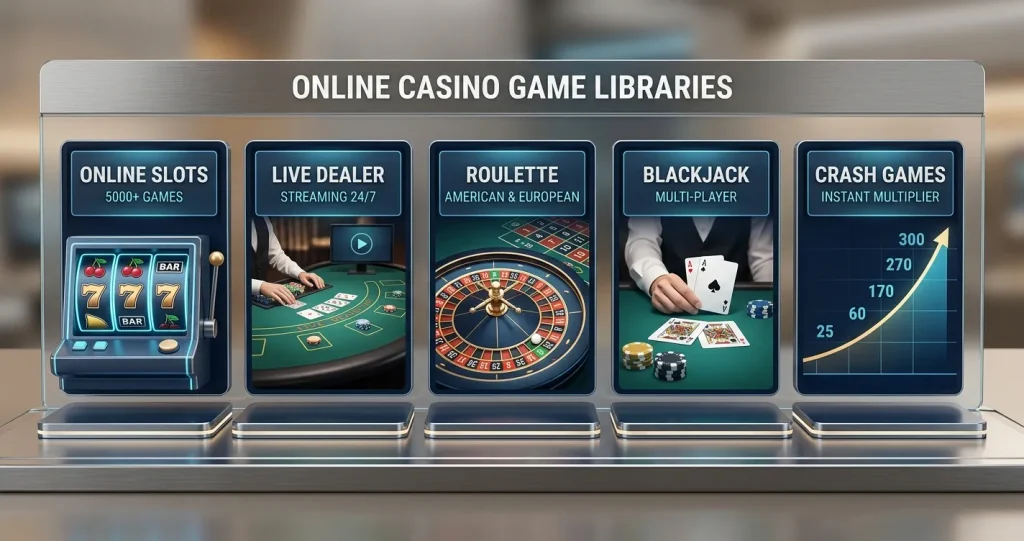
Fortune Clock offers four main game categories: slots, live casino, standard table games and crash games. The table-game set includes blackjack, roulette and baccarat. That is enough to describe the shape of the library without relying on unstable claims about an exact total number of titles. Provider rosters and individual games can change, so category breadth and the current live lobby are more useful than treating one catalogue figure as permanent.
Slots are the obvious centre of gravity, while live-dealer and table sections add a different style of play and crash games provide short, high-variance rounds. The right way to judge the library is by depth inside the categories you actually use, not by a headline game count.
Table of Contents
- Fortune Clock game categories at a glance
- Slots are the main library test
- How to judge the slot selection without an inflated game count
- Live casino quality depends on table choice and availability
- Table games: blackjack, roulette and baccarat
- Crash games: simple mechanics, concentrated risk
- Mobile game quality matters more than a separate app icon
- Catalogue claims that need manual verification
- UK market context: why slots deserve extra scrutiny
- A practical game-library test
- Responsible play by game type
- Questions about the Fortune Clock game library
- What the game selection means in practice
- Recommend
Fortune Clock game categories at a glance
| Category | Current status | What to check in the live lobby |
|---|---|---|
| Slots | Available | Provider filters, volatility information where shown, demo access and current title depth. |
| Live casino | Available | Dealer tables, languages, table limits, opening availability and mobile layout. |
| Table games | Available | Blackjack, roulette and baccarat variants, rule sets and minimum stakes. |
| Crash games | Available | Round speed, controls, rules and whether the format suits your risk tolerance. |
This category-level view is more durable than a precise catalogue number. Exact totals are sensitive to provider agreements, regional restrictions and regular title rotation. Unless a current lobby count has been manually checked, presenting a large number can create an impression of precision that the source does not support.
Slots are the main library test
For most casino players, the most meaningful depth question is not whether slots exist but how broad the selection feels once you filter by provider, mechanic and volatility. Slots are a core Fortune Clock category. Current public listings show a substantial range of slot titles, while the live lobby remains the best place to check the changing total.
A strong slot lobby should make discovery easy. Look for filters that help you move beyond the first promotional row: new releases, popular games, provider filters, jackpots or mechanics where available. The practical test is whether you can find several relevant options quickly without scrolling through duplicated or poorly organised tiles.
UK market context explains why slot quality matters so much. The Gambling Commission’s 2024/25 industry statistics report that online casino games produced £5.0 billion in gross gambling yield, with £4.2 billion coming from slots. That does not describe Fortune Clock specifically, but it shows why slots dominate the broader British remote-casino market. Official reference: Gambling Commission industry statistics for 2024/25.
How to judge the slot selection without an inflated game count
- Check provider spread. A broad mix can matter more than hundreds of near-identical titles from one studio.
- Use search and filters. A large library has little value if finding a specific mechanic or volatility profile is difficult.
- Open several games. Make sure the titles load correctly on your device and that game information is readable.
- Check demo availability where offered. Demo play can help you understand mechanics without immediately staking money.
- Read the paytable. RTP, volatility and feature rules belong to the individual game, not to the casino as a whole.
- Do not assume bonus eligibility. A game can be available for real-money play while contributing differently to a promotion. Check the bonus terms separately.
Live casino quality depends on table choice and availability
Fortune Clock has a live-casino category. Live-dealer games recreate parts of the table-casino experience through streamed tables, but the value comes from the specific selection and interface rather than the label itself. Roulette, blackjack and baccarat are the obvious formats to inspect first.
Before choosing a table, check the minimum and maximum stakes shown in the game, the table rules, language and any side-bet options. Live tables can have different limits even when they are versions of the same core game. They also depend more heavily on connection quality than ordinary RNG games because the video stream and betting window must remain synchronised.
For a UK reader, another practical question is session pace. Live tables can feel slower than rapid slots but can still encourage long sessions because rounds continue continuously. Use time and spending controls that fit the format rather than assuming a slower-looking game automatically means lower risk.
Table games: blackjack, roulette and baccarat
Fortune Clock’s table-game coverage includes blackjack, roulette and baccarat. These may appear as RNG versions, live-dealer versions or both. The distinction matters: the mathematical rules of a game can vary by version, and live tables can add different limits or side bets.
For blackjack, inspect the rules before playing, including deck count and dealer behaviour where disclosed. For roulette, identify whether the wheel is single-zero, double-zero or another variant because that changes the house edge. For baccarat, look at the commission and payout rules attached to the table. Rules can vary by individual game version, so deck, wheel and payout details should be checked at title level.
A good table-game section should make these differences visible rather than presenting every roulette or blackjack tile as interchangeable. If the game information panel is difficult to find, that is a usability weakness even if the category itself is well stocked.
Crash games: simple mechanics, concentrated risk
Crash games are also available at Fortune Clock. The core mechanic is usually easy to understand: a multiplier or event progresses until a random stopping point, and the player aims to exit before it ends. Simplicity can make these games feel transparent, but it does not make them predictable.
The short round length is the main behavioural consideration. Many decisions can happen in a small amount of time, which can increase the temptation to chase a previous outcome. If you use crash games, set a fixed budget and session boundary before starting. Do not interpret a sequence of recent rounds as a reliable signal about what comes next.
Mobile game quality matters more than a separate app icon
Game-library quality should be tested on the device you actually use. A catalogue can look strong on desktop while particular live tables or feature-heavy slots feel cramped on a phone. Check loading, portrait and landscape behaviour, bet controls, paytable access and whether the game returns cleanly after switching tabs or losing connection.
The casino’s broader mobile experience is covered in the mobile casino guide. Check the games you care about on mobile rather than assuming the entire desktop lobby performs identically on a smaller screen.
Catalogue claims that need manual verification
Some game-library details are best checked directly in the current lobby because they change too often to treat as static facts. These include the exact number of games, the exact number of providers, the presence of a particular named title, live-table opening times and any region-specific game restrictions.
The useful comparison is the structure of the game library: category breadth, provider variety, table formats and how easily the lobby exposes the games a player actually wants.
A practical lobby check should sample each category rather than stop at the homepage. Open several slot providers, compare the live tables available at the same time of day, inspect at least one blackjack and roulette variant, and confirm that crash titles are easy to locate. This shows whether the advertised category breadth translates into usable choice rather than duplicated or hard-to-find titles.
Provider labels are also useful for judging depth. A library can look large because it contains many variants of similar games, while another can feel broader because different studios contribute distinct mechanics and table formats. Filtering by provider, category and recently played titles gives a more practical picture of the catalogue than one headline total.
UK market context: why slots deserve extra scrutiny
The Gambling Commission’s 2024/25 statistics show that slots supplied most of the gross gambling yield from online casino games in Great Britain. That market fact helps explain both the prominence of slot lobbies and the importance of responsible-play controls around fast, repetitive formats.
Market statistics describe British gambling behaviour and regulated-market activity; they do not establish Fortune Clock’s regulatory position. For that separate question, read the licence and trust context page.
A practical game-library test
- Pick your three most-used categories. Do not let a huge total distract from weak depth where you actually play.
- Search for several representative titles or mechanics. Test whether discovery tools make the catalogue usable.
- Open the game information. Confirm rules, RTP information where provided, stake controls and any special features.
- Test one live table. Check video stability, betting-window clarity and table limits.
- Test on mobile. Make sure essential controls remain readable and easy to reach.
- Check responsible-play tools before long sessions. The speed of slots and crash games can make preset boundaries particularly useful.
This process gives a better answer to “is the game library good?” than simply counting thumbnails on the home page.
Responsible play by game type
Different categories create different decision rhythms. Slots and crash games can produce many outcomes quickly, live casino can encourage extended continuous sessions, and table games can tempt players to alter stakes after wins or losses. A single generic spending reminder therefore misses useful detail.
Choose controls around the behaviour of the format. For fast games, use a fixed session budget and time boundary. For live or table play, decide your stake range before joining a table. Do not increase bets to recover previous losses. Treat every game as entertainment with a cost rather than a way to generate income.
Questions about the Fortune Clock game library
Does Fortune Clock have slots?
Yes. Slots are a core Fortune Clock category. Catalogue totals change and should be checked in the current lobby.
Does Fortune Clock have a live casino?
Yes. Live casino is available. Check the live lobby for current tables, limits and language options.
Can I play blackjack, roulette and baccarat?
Yes. Blackjack, roulette and baccarat are documented Fortune Clock table-game categories. Individual versions can have different rules and stakes.
Are crash games available?
Yes. Crash games are part of the library. Their fast round structure makes preset spending and time limits especially important.
How many games does Fortune Clock have?
The catalogue changes, so a current lobby check is required before treating a precise game count as reliable.
What the game selection means in practice
Fortune Clock covers the main casino-game categories a reader would expect to compare: slots, live casino, blackjack, roulette, baccarat and crash games. The strongest way to assess that library is to test category depth, rules, filters and device performance rather than rely on an exact game-count headline.
Slots deserve particular attention because they dominate the wider British online-casino market, but that market context does not determine Fortune Clock’s licence status. For the complete operator assessment, return to the full Fortune Clock review.