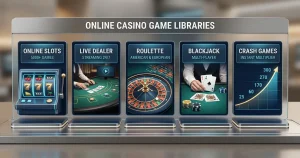
Live casino game shows are a broad category, so their presentation and availability depend on the individual casino offering.

Live game shows sit within the wider range of entertainment offered by online casinos. The label points to a show-like format presented live, rather than to a single game or a guarantee that every casino will offer the same experience. For you, the useful starting point is to treat it as a category: a way casino entertainment may be organised, not a description of one fixed product.
That distinction matters because an online casino is a venue for different kinds of gambling entertainment. A live game show may appear alongside other casino content, but its presence does not tell you what else is available, how the games are presented or whether the same titles can be found elsewhere. The category is broad enough to invite comparison, yet the details belong to the individual offering.
A live presentation can make the activity feel closer to a hosted programme than to a conventional digital game. It is still part of a gambling service when participation involves wagering. The show format does not change the underlying point: you are using a casino product, and the operator providing it is responsible for the gambling service offered to its customers.
If you’re choosing an online casino for game shows in the UK, payout information is one practical detail to check alongside the games on offer. Use this list as a starting point for your research.
Chanze
You’ll find Chanze listed with a payout speed of 1–3 business days.
Dieselwin
Dieselwin is listed with a payout speed of 1–3 business days.
WinBeast
WinBeast is listed with a payout speed of 1–3 business days.
Jetsetspins
Jetsetspins is listed with a payout speed of 1–3 business days.
NightWin
NightWin is listed with a payout speed of 1–3 business days.
Britsino
Britsino is listed with a payout speed of 1–3 business days.
Amunbet
Amunbet is listed with a payout speed of 1–3 business days.
EvoSpin
EvoSpin is listed with a payout speed of 1–3 business days.
Zombillion
Zombillion is listed with a payout speed of 1–3 business days.
Revery Play
Revery Play is listed with a payout speed of 1–3 business days.
This is also why the word “live” should not be treated as a quality mark. It describes the mode of presentation, not whether a particular game will suit you, how it works or what outcomes to expect. A polished presentation cannot establish that an offer is appropriate for your circumstances. Those are separate questions, and it is sensible to keep the entertainment format distinct from the decision to gamble.
For UK readers, the regulatory setting is part of that starting point. The Gambling Commission oversees gambling activity in the United Kingdom, including online casinos. In Great Britain, it is the sole regulator for commercial gambling. Its remit over remote gambling offered to consumers in Great Britain does not depend on where the operator’s key equipment is located. A service being presented online, or broadcast from equipment elsewhere, does not by itself place it outside that regulatory scope.
The Commission grants operating licences to businesses and personal licences to individuals working in relevant roles. These are different forms of authorisation: one concerns the business providing the gambling service, while the other relates to people operating within the industry. For you, the key context is that a live game show is not separate from the casino’s regulatory responsibilities simply because it is presented as a show.
The phrase “live game shows casino” can suggest a special kind of venue, but in practice it is more useful to think of the show as one part of an online casino’s wider catalogue. A casino may group content by format or presentation, and the category may be visible as a distinct area. That does not make it a separate regulatory class or mean that a casino devoted to this format has different basic responsibilities from another remote gambling operator.
That matters because names, availability and the way a casino presents its catalogue can vary.
The UK setting also deserves a careful distinction. The Gambling Commission’s stated remote-gambling remit concerns consumers in Great Britain, while the United Kingdom includes Northern Ireland as well. It is therefore more precise to refer to Great Britain when discussing that specific regulatory scope, rather than implying that every part of the UK is governed in exactly the same way. The Commission regulates gambling activity in the UK, but its role and legal framework should be described accurately.
For now, the central point is simple: live game shows are one form of online casino entertainment, and when they involve gambling they remain part of the operator’s gambling service. Their show-like presentation may make the category feel distinct, but it does not replace the casino context or the regulatory framework around remote gambling. This gives you a sound basis for approaching the subject without assuming that every casino offers the same content, or that the format itself tells you whether a particular choice is right for you.
“Casino game show” is a broad label for casino entertainment presented with the look and language of a televised game show. In a live-casino setting, it generally points to a hosted format that combines a show-like presentation with a gambling game. The phrase describes a style of entertainment, rather than one precise set of rules or a single product type.
That distinction matters because “live casino” is itself a wider category. It can include games presented by a live host as well as formats designed around a studio-show atmosphere. A game show may therefore sit within a casino’s live offering, but not every live-casino game is a game show. The terms overlap without being interchangeable.
The show element is about how the game is framed for viewers and players. It may use a host, a set designed for entertainment, or language associated with quizzes and television programmes. Those signals can make a casino game feel different from a traditional table game, even though both may appear in the same live-casino area.
There is no single definition that guarantees the same structure wherever the label appears. One provider or casino may use “game show” for a particular kind of hosted game; another may group several different formats under a similar heading. The name alone does not establish the rules, how a round works, or whether the format involves a live presenter. Those details belong to the individual game’s own description.
This is why it helps to separate the visual idea from the game itself. A brightly staged presentation does not, on its own, tell you what decisions are available or how an outcome is determined. Equally, a live host does not automatically make a game a show-style casino title. The label is a useful signpost, not a complete explanation.
When people refer to live casino game shows, they usually mean casino games delivered in a live-show style rather than every game broadcast from a studio. In that sense, the phrase narrows the wider live-casino category. It points towards entertainment-led presentation while leaving the exact format open.
The word “live” can also be understood in more than one way in everyday descriptions. It may refer to a presentation involving a live host, while “game show” describes the format’s entertainment style. The full label is often used to bring those ideas together. It should not be taken as a guarantee that every title described this way uses the same technology or follows the same approach.
“Online” simply places the experience in a remote casino setting. It does not change the meaning of “game show” or tell you whether a particular title is available to you. A casino’s category labels may help you recognise the general style, but the game information is what clarifies what is actually being offered.
Casino menus are built to help people browse, and their categories may be chosen for convenience rather than to express a formal industry definition. A title might appear under a live section, a game-show section, or more than one category. That does not necessarily mean the game has changed; it may reflect how the casino organises its catalogue.
The phrase can also be used casually to describe a lively casino game, even when the person using it has not checked whether the game is hosted or genuinely show-based. If you are trying to understand a specific title, treat the category name as an introduction. Read the game’s own description to learn what the title involves, rather than relying on its placement or promotional wording.
Similarly, asking for the “best” live game shows does not identify a shared standard of quality. People may mean the most entertaining presentation, a preferred type of game, or simply titles that fit the category. The label alone cannot answer those different preferences, and a general category should not be mistaken for a ranked selection.
In short, casino game shows are best understood as a show-oriented part of live-casino entertainment, not as a precise rulebook category. The terminology helps you recognise the intended style; the individual game description tells you what that style means in practice.
A live casino game show brings a hosted broadcast and a playable game into the same online experience. You watch events unfold on screen while using a separate game interface to take part. That makes it different from a standard video slot, where the action is generated on your device without a live host presenting it.
The screen may include a presenter, graphics and prompts connected with the game’s rules. The presenter provides a focal point, but the broadcast does not change the fact that you are taking part in gambling. Your choices, where the game allows them, and the way outcomes are determined depend on that particular game’s rules. Read those rules before you stake money; a lively presentation is not a substitute for understanding how play works.
The experience has two parts: the live picture and the controls used to play. Depending on the game, the interface may invite you to make a selection or confirm a stake before an outcome is revealed. Do not assume that every live show offers the same interaction, or that watching the presenter means you control what happens. The game rules explain which actions belong to you and which parts are determined by the game.
A live stream also makes timing more noticeable than it is in a game that runs entirely on your device. You may see a presenter speaking while the game interface shows a separate prompt or result. If the stream pauses, becomes unclear or appears out of step with the controls, stop rather than guessing what has happened. Check the game’s instructions or the operator’s help information before continuing.
The format is designed to hold attention through presentation as well as play. That can make a session feel more like watching a programme than using a conventional casino game. Keep the distinction clear: the host and studio atmosphere are part of the presentation, not evidence that outcomes can be predicted or influenced. A confident presenter, energetic graphics or a dramatic reveal does not alter the rules.
Live casino game shows can move at a different pace from games that let you pause between every action. Prompts and rounds may encourage you to act while the broadcast continues. You do not need to follow every prompt or keep playing simply because a new round is beginning. If you feel rushed, leave the game and take time to decide whether you want to return.
Before joining, check what the game says about stakes, available actions and how an outcome is settled. The UK’s online slot stake limits apply to online slots; do not assume that every game-show format is a slot or that the same rules describe every product. For real-money play in Great Britain, the operator must hold a UKGC licence. The regulator oversees remote gambling offered to consumers in Great Britain, including when key equipment is located elsewhere.
Live presentation can make time pass quickly, especially when one round leads directly into another. Decide in advance how long you want to spend and what you are prepared to lose, and stop when either boundary is reached. A pause is useful if you are no longer following the rules or are playing mainly to recover a previous loss. The broadcast will continue without requiring you to take part.
The online version is still a casino game, not simply a show to watch. Treat the stream as presentation, the game rules as the basis for participation, and your own limits as a reason to step away when needed.
A game-show title can look appealing in a lobby, but that alone tells you little about whether it suits you. Before choosing where to play, assess the operator, the information available about the game and the practical controls you can use. This is a more reliable approach than treating “best” as a universal verdict: what feels manageable for one person may not suit another.
For real-money play in Great Britain, the operator must hold a current UKGC licence. Check the licence against the Gambling Commission’s Public Register rather than relying on a logo or a claim elsewhere on the site. A supplier’s involvement is not a substitute for the casino operator’s licence: it is the operator that accepts deposits, pays winnings and handles your account and support.
Read the operator’s terms before depositing. Look for the rules that apply to your account, including payment conditions, withdrawal requirements and any restrictions attached to promotions. If an offer makes it difficult to tell when winnings can be withdrawn, pause before accepting it. Promotional wording is not a replacement for the full terms.
You should be able to find the rules before committing money. Check that the game explains how to take part, what the available choices mean and how outcomes are settled. If a rule or on-screen instruction is unclear, do not assume that you will understand it once a round is underway. A game that leaves you uncertain about what you are doing is a poor fit, regardless of its presentation.
Pay attention to the controls as well as the entertainment. Can you see the stake before confirming it? Is it clear how to stop or leave? Can you tell when a choice is final? These are practical questions, not guarantees about results. No description or visual presentation can make an uncertain outcome predictable.
A UKGC-licensed operator must prompt you to set a financial limit before your first deposit. Consider that prompt carefully and choose a limit that reflects what you can afford to lose, not what you hope to win. A reduction to a limit must be actioned immediately. If you want to stop gambling altogether, GamStop is mandatory across GB-licensed online operators and can be relevant when comparing the support available.
Do not treat safeguards as a reason to play more. They are there to help you keep control, and setting them before depositing is more useful than trying to make decisions after a session has started. If you find yourself raising limits to continue, or playing to recover losses, stepping away is a sensible response.
A show’s pace, presentation and level of interaction may matter to you, but they do not indicate how much you will win. Think about whether you can follow the instructions without rushing and whether the experience remains comfortable when you are not winning. If the answer is no, choosing another form of entertainment—or not playing—is a reasonable decision.
Set your own stopping point before you begin, and do not use borrowed money or money needed for essentials. There is no need to decide on a game because it is labelled popular or described as a leading choice. A sound assessment is about clarity, control and the operator’s obligations, not a promise that one game will deliver a better outcome.
Finding a casino with live game shows is a matter of checking its current catalogue, not relying on a general claim that it offers live casino games. A lobby may group titles under labels such as “Game Shows”, “Live Games” or “Live Casino”, but the wording and layout differ between operators. Use the site’s own categories or search function, then open the relevant entries to confirm what is actually available.
If a category is not easy to find, check the casino’s help pages or ask customer support whether live game shows are offered to customers in your location. Be specific: ask about the live-show category, rather than live casino games generally. An operator may use that broader label for other formats, so it is worth confirming that the catalogue matches what you are looking for.
Use the site's search function or categories to find the game. If it is not visible, contact customer support to ask specifically about the live-show category for your location, and verify the title within your logged-in account.
Treat availability as something to verify before you create an account or deposit. A title shown in promotional material may not appear in the logged-in lobby, and a catalogue can change. If you already have an account, check from within it as well as on any public pages. If the game is missing, ask the operator whether it is temporarily unavailable or not included in your account’s offering; do not assume that a page describing it means you can play it.
For customers in Great Britain, real-money casino play must be offered by an operator with a UKGC licence. The Gambling Commission regulates remote gambling offered to people in Great Britain, even when key equipment is located elsewhere. A provider’s presence in a game description is not a substitute for the casino operator’s licence: the operator is responsible for offering gambling to customers. Before depositing, make sure you are dealing with a licensed casino, rather than a site merely advertising access to casino games.
Check the operator’s terms and account information for any conditions that affect access. If something is unclear, get an answer from the operator before paying in. Keep the reply and the page where you found the relevant details, so you can refer back to them if the catalogue or its presentation changes.
You do not need to choose a casino solely because its homepage highlights live entertainment. Start with the actual lobby, confirm that the category contains the kind of show you mean, and check that access is available to you. If the information is vague, pause rather than treating an advert or a broad “live casino” label as confirmation.
If you are looking for Crazy Time or Funky Time, treat each name as a starting point for checking a specific listing, not as proof of what a casino offers. A page may use a name in a headline or promotional description without making clear what is actually available to play. Look for the title in the casino’s own lobby and open its information page before relying on a third-party description.
Check that the name shown in the lobby matches the one you intended to find. Similar wording, a related promotion or a page discussing several titles may not identify the same game. If the casino provides a separate game information screen, use it to confirm how the title is categorised and what kind of experience it describes. Do not infer rules, features or a live presentation from the name alone.
The word “live” also needs context. A description should make clear whether it refers to a live-hosted game or is simply part of the page’s wording. If the listing does not explain this, you cannot safely establish the format from the title. Check the casino’s own description rather than relying on a search-result snippet, which may omit qualifications or refer to an older page.
Before signing up, confirm that the operator serving you holds a current UKGC licence. Remote gambling operators offering services to people in Great Britain must be licensed by the Gambling Commission, even if their key equipment is located elsewhere. A familiar title or polished page does not establish that the casino itself is licensed. You must be at least eighteen to gamble legally at a UK-licensed online casino.
Pay attention to who is responsible for the account. The casino operator, rather than a game supplier, handles deposits, payouts and customer support. If a page leaves the operator unclear, or sends you elsewhere to play, pause and establish which company would hold your account and deal with any problem.
Promotional pages can also blur the distinction between a named game and an offer connected to it. Read the terms for the offer itself, including any conditions on withdrawing winnings, rather than assuming that the title’s name tells you how a promotion works. If the terms do not clearly explain what applies, do not treat the headline as a substitute.
These checks are specific to searches for Crazy Time and Funky Time: verify the exact listing, its description and the licensed operator behind it. A name on its own is not enough to establish what is being offered or who is accountable for your play.
A casino’s general claim that it offers live entertainment does not confirm that live game shows are available to you. Check the catalogue for the specific account and location you intend to use, and treat a game’s presence in a promotional image or an old review as a reason to verify—not as proof that you can open it now.
Start with the operator’s own lobby. Look for a live-casino area and any category or filter that identifies game shows. If the catalogue has a search function, use it to check the titles you have in mind. Open a result rather than relying only on a thumbnail: the game page can show whether it is accessible or whether the operator displays a restriction. If you cannot find a clear answer, ask the operator’s customer support to confirm availability for your account before depositing.
Check that you are looking at the UK-facing service, not a page intended for customers elsewhere. A brand may operate different services, and a catalogue shown in another region does not establish what is offered to British customers. The operator’s own terms and help pages should identify the service and any relevant access conditions. Save or note the answer if availability is important to your decision, then check again before playing; a catalogue can change.
For real-money play in Great Britain, the operator must hold the appropriate UKGC licence. Check the company named in the casino’s terms against the Gambling Commission’s Public Register. A provider’s licence is not a substitute for the operator’s licence: the operator is responsible for the gambling service it offers to customers. This matters when a game appears in a lobby, because a listing alone does not establish that the service is properly licensed.
Be precise about what you have confirmed. A game listed in a catalogue may not be accessible from your account, while a support response about one title does not confirm that every live game show is available. If you are comparing live game shows online at a UK casino, verify the individual listing and the operator’s status rather than relying on a broad claim that its live section is extensive.
You must be aged eighteen or over to gamble legally with a UKGC-licensed operator. If you cannot establish that the relevant game is available on the operator’s UK service, or cannot identify the licensed operator responsible for it, do not treat a third-party page as confirmation. The safest check is a direct one: the current UK-facing catalogue, the operator’s terms, and the Gambling Commission register.
A useful comparison is not about finding one show that is objectively best. It is about noticing how different live formats may ask for your attention, and whether their style suits the way you want to play. A familiar name or polished presentation cannot tell you whether you will enjoy the pace once a session begins.
Start with the role you have as a participant. Some formats may keep your involvement largely to choosing a wager before an outcome is revealed; others may present choices or stages that invite closer attention. Check the rules within the game itself rather than assuming that a lively set or host means you have more influence over the result. Presentation and control are not the same thing.
Pace is another useful point of comparison. Consider how quickly a round moves from one decision to the next, how much explanation appears on screen, and whether you can follow the sequence without feeling rushed. A brisk format may suit someone who wants little interruption; a more measured one may be easier to follow when its rules or features need attention. These are preferences, not signs that one format is inherently better.
Look at how clearly the show explains its outcomes and any special features. Can you understand what each choice does before committing money? Are the relevant rules accessible from the game screen? If a description leaves you uncertain about what a selection means, pause rather than treating the uncertainty as part of the entertainment.
The atmosphere matters too, but it should be considered separately from the underlying terms. Hosts, graphics, sound and chat can make a show feel more social or theatrical. They do not establish the odds, payout structure or value of a wager. Read the rules and displayed information for those points, and do not let the pace of a presentation push you into a decision.
When comparing live casino game shows, make a short personal checklist: how much attention the format requires, whether its rules are easy to follow, how comfortable you feel with its rhythm, and whether the presentation adds to your enjoyment. If you are weighing up the best live casino game shows for your own preferences, those practical differences are more useful than a universal ranking. Set a spending limit before play, and stop if the experience no longer feels comfortable.
If you want a casino experience centred on live game shows, decide what you want that focus to mean before opening an account. You might prefer to spend your time in a live-show lobby rather than move between unrelated casino games, or simply want live shows to be one part of a broader choice. Being clear about that distinction can help you avoid signing up for an experience that does not suit you.
Consider how you want gambling to fit into your routine. A live format can make play feel more immediate, so set a spending limit you can afford before you begin and stop when you reach it. At UKGC-licensed operators, you must be prompted to set a financial limit before your first deposit; if you lower that limit, the change must take effect immediately. These controls are useful, but they do not decide your budget for you.
The operator matters as much as the entertainment. In Great Britain, a business offering real-money remote gambling must hold a UKGC licence. That licence belongs to the operator serving you, not necessarily to the company that supplies a game. A live-show-themed lobby is not a substitute for checking who runs the casino and whether it is licensed.
Also think about whether you want to be able to step away easily. GamStop is available across UKGC-licensed online operators, and you can use it to exclude yourself from participating sites if gambling is no longer manageable. If you are already unsure whether you want to play, delaying the decision is a reasonable choice.
Choose an experience that fits your limits and expectations, rather than one that encourages you to spend longer or more than planned. The right choice is not the busiest lobby; it is one you can leave without chasing losses or compromising your budget.
Access begins through a casino’s remote gambling service, but the route to a particular game show depends on what that operator makes available. A title appearing in an online catalogue does not, by itself, confirm that you can open it on your device or account. Check the operator’s own game information and access terms before depositing; avoid assuming that a game will work in a browser or app simply because the casino itself does.
For real-money play in Great Britain, the operator must hold a UKGC licence. The UK Gambling Commission regulates remote gambling offered to people in Great Britain, even when the operator’s equipment is located elsewhere. A site operating under an offshore licence is outside that system, so it does not provide the same UK regulatory protections.
Before you can deposit, the operator must verify your age, name and address. You must be at least eighteen to gamble legally with a UKGC-licensed operator. The operator must also prompt you to set a financial limit before your first deposit; if you lower that limit, the change must take effect immediately. These steps are part of account access, not optional settings to leave until later.
If you use GamStop, remember that it applies to UKGC-licensed online operators. Do not treat access through an offshore site as a workaround: those casinos are not covered by GamStop or UKGC complaint routes.
Once signed in, follow the operator’s own instructions for opening the game. If it will not load, or access is restricted, contact that operator’s customer support rather than trying another site with a different regulatory status. The operator is responsible for account access and support; a game supplier does not take your deposit or pay your winnings.
Yes. Amatic holds a UK Gambling Software (Remote) licence, and its games are supplied to UK players through UKGC-licensed operators. The casino operator is responsible for your account, deposits and payouts.
Yes, when you play them through a Great Britain-licensed online casino. GamStop applies to the operator and its gambling service, not to Amatic games as standalone products.
No. Amatic supplies games rather than running consumer-facing casinos, so any welcome bonus or free spins are offered by the casino operator.
Amatic slots generally run in mobile browsers as HTML5 games, so you do not need to download an app.