Fortune Clock Casino Licence, UKGC Status and Trust Context
 Available in GB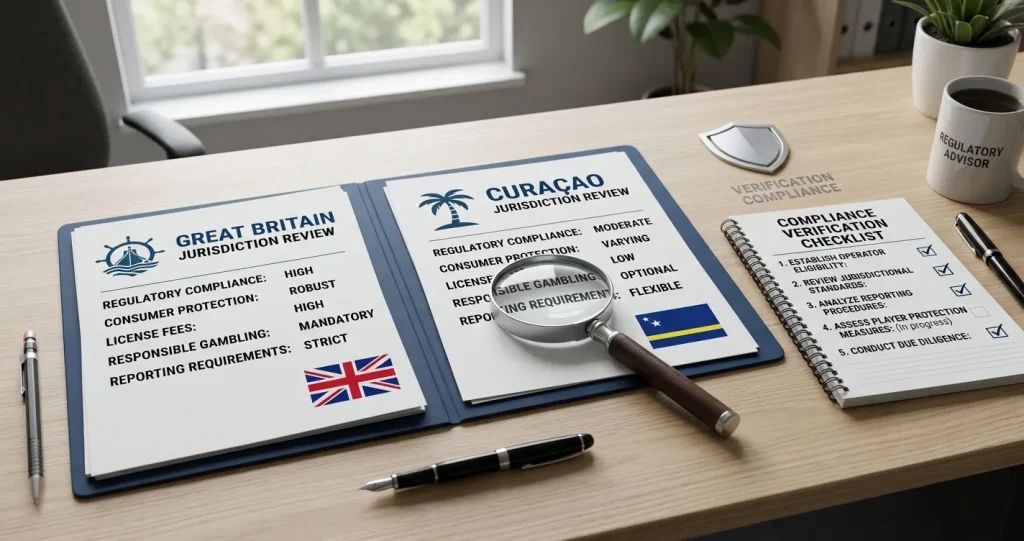
Fortune Clock operates under a Curaçao licence, while the UK Gambling Commission public business register does not show a Fortune Clock licence. That distinction is the main fact a UK reader needs to understand. A Curaçao licence and a UKGC licence are not interchangeable, and UKGC consumer-protection coverage, dispute handling and supervision should not be assumed for Fortune Clock.
Great Britain requires a remote casino operator serving consumers in England, Scotland or Wales to hold the appropriate Gambling Commission operating licence, regardless of where the business is based. The practical question is therefore not whether Fortune Clock has “a licence” in the abstract, but which regulator stands behind it and which protections follow from that jurisdiction. For the broader product picture, see the full Fortune Clock review.
Table of Contents
- Fortune Clock licence status at a glance
- What the UKGC register check establishes
- Curaçao licensing is a different regulatory relationship
- What UKGC licensing means in Great Britain
- GAMSTOP and the meaning of “non-GamStop”
- Consumer-protection implications
- Licence status and product features are separate questions
- A practical trust checklist before depositing
- Fortune Clock licence FAQ
- Bottom line for UK readers
- Recommend
Fortune Clock licence status at a glance
| Question | Current finding | What it means for a UK reader |
|---|---|---|
| Does Fortune Clock have a gambling licence? | Curaçao is the documented licence jurisdiction in current public information. | The brand is not presented as unlicensed in general. |
| UKGC public-register result | No Fortune Clock, fortuneclock.com or identified operator-alias licence match appears in the UKGC public business register check. | Do not assume UKGC oversight or protections apply to this casino. |
| Is the exact Curaçao licence number established? | No. | The jurisdiction is documented, but a sufficiently reliable current licence number is not established. |
| Is Fortune Clock covered by GAMSTOP because it serves UK users? | No such coverage is claimed. | GAMSTOP participation is tied to companies licensed for online gambling in Great Britain. |
| Does the licence finding change game, payment or mobile facts? | No. | Licence status is assessed separately from product features. |
What the UKGC register check establishes
The Gambling Commission maintains a public register of licensed gambling businesses. Its business register can be searched by business name, trading name, domain name or account number. Checks for Fortune Clock, fortuneclock.com and operator names cited by third-party sources did not verify a Fortune Clock entry carrying a UKGC operating licence.
That result supports one narrow statement: the UK Gambling Commission public register does not show a Fortune Clock licence. It does not prove every possible legal or commercial fact about the brand, and it is not a basis for assigning an operator identity where secondary sources conflict. Different company names appear across those sources, so none should be treated as settled ownership without stronger current documentation.
Readers who want to understand what the register contains can use the Gambling Commission business register. Checking the register directly is more reliable than relying on an old review badge or copied footer claim that may no longer reflect the current licence record.
Curaçao licensing is a different regulatory relationship
Fortune Clock’s licence jurisdiction is documented as Curaçao across current public information. That is a factual jurisdiction statement, not a claim that Curaçao rules are equivalent to the British licensing system. Regulators set different licensing conditions, enforcement structures, complaint routes and responsible-gambling requirements, so the label “licensed casino” should always be followed by the question “licensed where?”
Current public information documents Curaçao as the licence jurisdiction, but a sufficiently reliable current licence number is not established. The jurisdiction can therefore be stated more confidently than an individual licence number.
For a UK reader, the useful comparison is structural. Fortune Clock is documented with Curaçao licensing and the UKGC public register shows no local Fortune Clock licence. Product features such as games, payments, mobile access and support remain separate questions. See the payment methods page for deposits and withdrawals.
What UKGC licensing means in Great Britain
The Gambling Commission states that remote operators providing gambling facilities to consumers in Great Britain need the appropriate operating licence, regardless of where the operator itself is based. The current remote casino licence guidance covers casino games offered through websites, mobile phones and other online services. Official reference: UKGC remote casino operating licence guidance.
A UKGC licence is more than a geographic label. It connects the operator to the Commission’s Licence Conditions and Codes of Practice and to specific remote gambling standards. Those rules include customer-protection duties that can shape how promotions, slots, self-exclusion and risk interaction work. These examples show why licence jurisdiction matters in practice rather than simply as a trust badge.
For UKGC-licensed online slots, the current maximum stake per game cycle is £5 for customers aged 25 and over and £2 for customers aged 18 to 24. Those limits came into force in 2025. They are British regulated-market rules and are not presented here as Fortune Clock product limits.
UKGC rules also cap promotional bonus wagering requirements at 10 times bonus funds for affected licensees, with the current requirement in force from 19 January 2026. Again, that benchmark should not be copied onto Fortune Clock’s own offer. If you want the brand-specific promotion picture, use the welcome offer details, which keeps UK market regulation separate from Fortune Clock terms.
GAMSTOP and the meaning of “non-GamStop”
GAMSTOP is the national online self-exclusion scheme used by gambling companies licensed in Great Britain. GAMSTOP states that all online gambling companies licensed in Great Britain must participate, and registered users are blocked from gambling with those participating licensed services for their chosen exclusion period. Official information is available from GAMSTOP.
The phrase “non-GamStop casino” is often used in search results as if it described a bonus feature or a special product category. It is better understood as a regulatory and self-exclusion distinction. A service outside the UKGC-licensed market should not be assumed to sit inside GAMSTOP simply because UK users can reach it or because it is discussed on UK-facing websites.
For someone who has registered with GAMSTOP in order to stop gambling, searching for casinos outside that scheme can undermine the purpose of self-exclusion. Absence from GAMSTOP should not be treated as a benefit. If self-exclusion is part of your current safer-gambling plan, use blocking tools and support options that reinforce that decision instead of looking for ways around it.
The same distinction also prevents a common factual error. “Not shown as UKGC licensed” does not mean “no responsible-gambling tools exist,” and “Curaçao licensed” does not mean “UKGC rules apply.” Those are separate claims that need to be checked independently.
Consumer-protection implications
The UKGC public register does not show a Fortune Clock licence, so UKGC licence-holder complaint processes, British regulatory enforcement protections and UKGC-required safer-gambling systems should not be assumed for the brand.
The opposite blanket claim is also too broad. The more precise regulatory facts are: the brand is documented under Curaçao licensing, while Great Britain requires the appropriate UKGC licence for remote operators serving British consumers and the public register shows no such Fortune Clock licence.
When trust matters, match each question to the relevant information: licence jurisdiction for regulation, payment terms for methods, withdrawal terms for cashout and account requests for KYC. Mixing those categories can create false confidence in both directions.
Licence status and product features are separate questions
One regulatory finding should not be used to rewrite unrelated product facts. The Fortune Clock licence result is separate from documented product features. If several sources support mobile-browser play, that feature remains supported. If payment methods are consistently documented, the payment claim should be checked against its own terms. If the brand has a welcome promotion, its existence is evaluated separately from the licence jurisdiction.
The reverse is equally important. A large game library, live chat or familiar payment method does not prove a UKGC licence. Product convenience does not establish regulatory status. A reader should therefore avoid both shortcuts: “it has good features, so it must be UK regulated” and “it is not UKGC licensed, so every product claim must be false.”
This distinction is especially useful during account setup. The registration and KYC page covers KYC without turning UKGC rules into Fortune Clock-specific promises; exact documents and review times should come from the current account request.
A practical trust checklist before depositing
- Verify the jurisdiction. Distinguish the Curaçao licence claim from a UKGC licence claim. Do not treat them as synonyms.
- Check the UKGC register yourself. Search the brand, domain and any clearly identified legal operator if UK licensing is important to your decision.
- Do not rely on badges alone. A logo or footer graphic is weaker signal than a current regulator register entry.
- Separate product claims from regulation. Verify payments, games, support and mobile access independently.
- Read current promotion terms. Do not assume the British 10x wagering cap governs a promotion unless the operator is actually subject to the UKGC rule.
- Check safer-gambling coverage. If GAMSTOP protection matters to you, confirm that the operator is within the scheme rather than assuming all UK-accessible casinos are covered.
- Keep ownership uncertainty visible. When public information disagrees about the legal operator, do not treat one convenient name as settled fact.
- Avoid unverified licence numbers. A precise number can look authoritative while still being stale, copied or linked to another operator.
Fortune Clock licence FAQ
Is Fortune Clock licensed by the UK Gambling Commission?
The UK Gambling Commission public register does not show a Fortune Clock licence, so UKGC licensing and UKGC consumer-protection coverage should not be assumed.
What licence does Fortune Clock have?
Curaçao is the documented licence jurisdiction in current public information. A sufficiently reliable current licence number is not established.
Is Fortune Clock a non-GamStop casino?
The useful point is that GAMSTOP covers online gambling companies licensed in Great Britain, while the UKGC public register does not show a Fortune Clock licence. Absence from GAMSTOP should not be treated as a benefit or a way to bypass self-exclusion.
Does no UKGC licence make every Fortune Clock feature uncertain?
No. Licence status is separate from product features such as games, payments, mobile access, support and promotions.
Do UKGC slot and bonus rules automatically apply to Fortune Clock?
No. UKGC stake limits and the promotional wagering cap are regulated-market rules for UKGC licensees, not Fortune Clock terms.
Bottom line for UK readers
Fortune Clock’s regulatory position should be described precisely: Curaçao is the documented licence jurisdiction, and the UK Gambling Commission public register does not show a Fortune Clock licence. UKGC oversight, GAMSTOP participation and UKGC consumer-protection mechanisms should therefore not be assumed for Fortune Clock.
The practical consequence is not that every other fact about the casino becomes uncertain. It is that a UK reader should evaluate regulation and product features separately. Use the regulator register for licensing, current operator terms for changing account conditions, and the dedicated pages for payments, promotions and account verification. That produces a clearer decision than either a generic “licensed” badge or an equally generic “offshore” label.